Another film on my "sorry when it's over" list is "Captain Horatio Hornblower" (or "Captain Horatio Hornblower R. N."). This is yet another vintage film I've enjoyed since childhood. As a matter of fact, when I was a kid it was pretty vintage. Granted, as enjoyable as the story is, there have been other films that have made me miss them more when "the end" appeared on the screen or the credits began to roll. But, I still feel that hint of being choked up when a fun and endearing experience comes to an end.
"Captain Horatio Hornblower" was released in 1951, and starred Gregory Peck, Virginia Mayo, Robert Beatty, Moultrie Kelsall, Terence Morgan, James Kenney and James Robertson Justice, and directed by Raoul Walsh. This film, in particular, was based on one of a series of novels by C. S. Forester about the service and life of the fictional character Horatio Hornblower. The series follows his career from midshipman to admiral and beyond. The title of the novel on which the film is based is "Beat to Quarters". (I had to read that when I was in school. Much to my surprise, it was really good. Even though I enjoyed the movie, I never expected the book to be as good. Not even a little bit. Needless to say, the surprise was a pleasant one.) Having seen the movie before reading the novel served to enhance the reading experience for me. I always enjoyed the aire of 1950's swashbuckler films. They always had something of a call to the escapist in me. The experience of the film bled over into the novel.

"Captain Horatio Hornblower" had what I would call a "larger than life" feel to it. From the very beginning, you're pulled right into the story. You're narrated right from backstory and setting to the present, which is a tall ship being towed across a windless sea. The movie starts out with a ship, the H.M.S. Lydia, in dire straits and with a grim outlook, literally on the other side of the world, attempting to carry out secret orders. Little by little the details of the orders and mission are revealed as the grim situation aboard ship plays out. The first thing that's shown is the nature of the captain and his command. Captain Horatio Hornblower shows himself to be a staunch advocate of naval regulations and a fierce supporter of the authority of his officers. But, at the same time, he manages to be something of a secret advocate of the rest of the crew as well. This can be seen when, in the opening scenes of the film, Captain Hornblower orders the crew assembled to witness the punishment of one of the crew reported for fighting. As the crewman is being punished, the captain reveals to the reporting officer, Mr. Gerard, the real reason why the crewman is being flogged. All at once the strict commander with a genuine concern for his crew. This serves to endear Captain Hornblower as a character. In fact, his mindfulness of the crew continues throughout the film. And it's answered by the crew's growing respect for him.

The officers of the H.M.S. Lydia have a kind of chemistry of their own. Particularly the first lieutenant and the navigator, Mr. Bush and Mr. Crystal. After sharing their alarm over the growing amount of time the Lydia remains becalmed, the captain joins their conversation and, in his way, reassures them with a prediction of their reaching wind and, within days, reaching their destination. A very specific destination which he describes in some detail. Mr. Crystal's skepticism and Mr. Bush's confidence provide the fuel for their amusing relationship during their service aboard the Lydia. It begins with a wager between them over whether or not the captain's prediction of towing into wind and reaching their destination will see fruition. For myself, this and consequent wagers between them, and seeing who wins, provides a measure of comedy as the story plays out aboard the Lydia.
With the reaching of their destination (as well as the final revelation of the nature and details of their overall mission in the Pacific), the captain meets the ally of the British monarchy Don Julian Alvarado or "El Supremo", as he calls himself. This guy is the perfect picture of ego nurtured into madness. Where this guy is concerned, the words "delusions of grandeur" just don't quite say it. Though it's pretty much by suggestion only, looking into this guy's eyes and listening to him talk, there's clear indication that his brutality matches his madness. "El Supremo" is the perfect picture of a frail, all-demanding ego that requires support and justification through ruthless brutality. Just the same, Capt. Hornblower handles him well.

Captain Hornblower's meeting with "El Supremo" marks the beginning of the first of the two great adventures in the film. Captain Hornblower comes away from his first meeting with "El Supremo" having accepted the task of capturing the "Natividad", a 60-gun ship of the Spanish line that has been sent in answer to "El Supremo's" revelation of hostility to the Spanish. This ship, the Natividad, out guns and out mans the Lydia. She is, for all intents and practical purposes, as far as the Lydia is concerned, undefeatable. This makes her the center of focus for this part of the film. Captain Hornblower, of course, has a plan to capture the Natividad, which he and the crew carry out quite successfully. But this isn't the high point of this particular adventure. This only opens the door to the twist in the relationship between Captain Hornblower and "El Supremo", and, what turns out to be the high point and climax of this adventure.

After having turned over the captured Natividad to "El Supremo", Captain Hornblower takes the Lydia south to blockade Panama against the Spanish as a part of his ordered assistance to "El Supremo". En route, he encounters a Spanish lugger flying a white flag and bringing news and passengers that change everything. The Spanish captain brings news that before Captain Hornblower could even begin his mission in the Pacific, the tide of the war in Europe had changed and Spain was now allied to England. With this news came the realization that the most powerful weapon in those waters was now in the hands of a brutal madman bent on
conquest. And to make matters worse, Captain Hornblower finds himself forced to take on two female passengers, the Lady Barbara Wellesley, a member of English nobility, and her maid, as they head out to find and engage the most heavily armed ship that side of the world. A tiny bit of mayhem and controlled chaos ensues.

The second encounter between the Natividad, now under the command of "El Supremo", and the Lydia began with the revelation of the loss of the element of surprise on the part of the Lydia. This is announced by a cannon shot from the Natividad once the ships have sight of each other. To the officers and men of the Lydia, the outlook of the impending battle is grim. They charge ahead against a ship twice the Lydia's strength. "El Supremo", with all the rage of his bent, power-obsessed ego, charges ahead in all the wind the Natividad's sails can carry. This puts her gun ports underwater on one side. This is an opening that no one but Captain Hornblower anticipates. Here begins the excitement as, with a quick maneuver across the Natividad's bow, the Lydia passes on the side of the Natividad that's listed into the water and, as her guns bear, unloads a full cannon volley into her without a single shot returned. And then, if that's not enough, being the more maneuverable ship, the Lydia manages to turn around, overtake the Natividad, and put another volley into her before she can return fire. Everyone is shocked. "El Supremo" is livid. (And I'm tickled to death. I can never get enough of this battle.)

The Lydia's advantage having been exhausted, she turns to face the remaining fury of the Natividad's guns. Mr. Bush, the first lieutenant, after singing Captain Hornblower's praises for his achievement against the Natividad, expresses his satisfaction with the well exploited advantage, "For what we are about to receive may we all be truly thankful." This is followed, in short order, by a broadside from the Natividad. And from this point on, it's a violent pounding match, escalating from passing shots as guns bear to a broadside facing firefight. Despite her strength, the Natividad was unable to recover from the Lydia's fire as quickly and effectively as the Lydia could from her's, and, in the confusion of trying to recoup from the Lydia's fire, "El Supremo" meets his end trapped beneath a fallen cannon. The Lydia ceases fire and the crew stand and watch as the Natividad burns, her hull being ripped apart as the powder magazine explodes. A victory well earned.

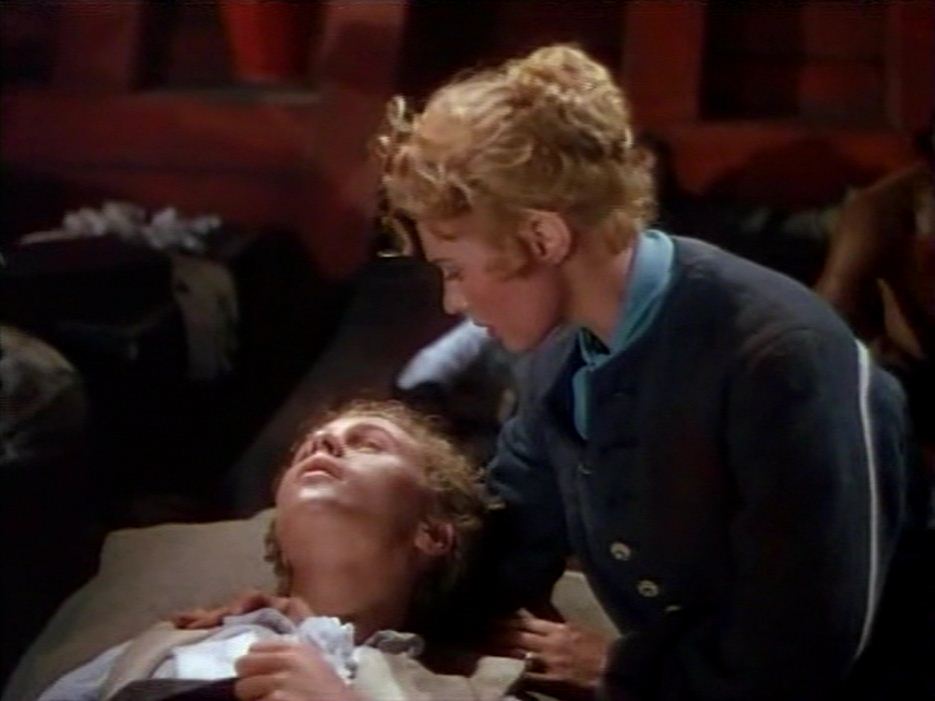
The Lady Barbara Wellesly proved herself in the heat of the Lydia's battle against the Natividad. When the fighting began and the wounded started to pile up, with the death of the surgeon, the Lady immediately went to work tending the wounded. After the battle, Captain Hornblower found the Lady tending the mortally wounded midshipman, Mr. Longley. Again, the captain's mindfulness of his crew is seen as, in a cloud of delirium, Mr. Longley sees his mother in the Lady Wellesly and asks her to kiss him goodnight as his mother did when he was a child. The Lady had no idea what to do. The captain deduced how this was done from his observation of how Mr. Longley's mother kissed him goodbye when the Lydia left England. This, the captain's attendance during Lady Wellesly's illness, and the events of the long journey back to England served to nurture the Lady's feelings for Captain Hornblower. And, despite the most noble of efforts, those feelings were not unrequited. The fact that the captain was married, and the Lady herself was engaged to Admiral Rodney Leighton, one of Captain Hornblower's superiors, pretty much put all the nails in the coffin of whatever hope there might have been for their feelings for each other. The awkwardness of the situation aboard ship
motivated Captain Hornblower to drive the Lydia as hard as he could to get back to England as quickly as possible.

Immediately upon their arrival back in England, the Lydia is boarded by Admiral Leighton himself, in the retrieval his fiance. The moment this guy opened his mouth, I couldn't stand him. His every word filled me with rage. And it got worse the more he talked. His criticism of Captain Hornblower's handling of his mission and his dismissal of sinking of the Natividad as "luck" just pissed me off. I wanted to choke him. My first thought was that this was nothing but jealous spite. His continued behavior served to confirm me in that opinion. I really hated this guy. It almost made my flesh crawl when it turned out that Captain Hornblower would be serving under him as one of the captains in his squadron in the next mission. And, in an act of crowning stupidity, he orders Captain Hornblower to take no initiative and not to risk his ship in anyway, effectively hobbling him in the execution of his part in the squadron's mission. (Poor Lady Wellesly.)
In the interim between adventures, he briefly visits home only to find that his wife has died giving birth to their son. This is coupled with the news that the woman he has fallen in love with is now married. It just keeps getting heaped onto when, being attached to Admiral Leighton's squadron, he's operationally hobbled in the carrying out of his mission.

At the beginning of the second great adventure of the film, Captain Hornblower shows a clearly superior understanding of the theatre of campaign by poking holes in the admiral's strategy for tracking down four ships escaped from Admiral McCartney's blockade. Despite Admiral Leighton's attempt to hobble Captain Hornblower, he manages to find out that his understanding of the situation in Europe and Napolean's strategy is correct and successfully tracks down the four escaped ships. He also manages to take advantage of the fact that the ship he's been assigned is a captured enemy ship retasked to serve the English fleet. Running across a small cargo ship serving the enemy, Captain Hornblower learns from her captain the enemy recognition signal. With this, he manages to find and sneak into an enemy port and surprise them, masquerading as an enemy ship. He manages to sucessfully dismast and cripple all four ships in the face of superior firepower coming from the fortress connected to the port. But, he does this at the cost his ship. Even still, he manages to put his ship at the mouth of the harbor, sinking it in a position that would effectively cut off the port from the rest of the sea, trapping any ship large enough to be a problem in the harbor.

Captain Hornblower succeeds in his mission at the cost of his ship and the capture of himself and his crew. Fortunately, however, the detail he sent aboard the captured enemy cargo ship found the rest of Admiral Leighton's squadron and apprised them of Captain Hornblower's intentions and subsequent location. Shortly after Captain Hornblower and his crew are incarcerated, Admiral Leighton's squadron arrives and attacks the fortress. Captain Hornblower and his first lieutenant, Mr. Bush, however, are taken from the fortress and sent on their way to Paris to face trial and execution. With the help of crewman Quist, who, rather forcefully, volunteers himself to assist the injured Mr. Bush during their journey, they make their escape, following a nearby river to a port. On their arrival at the port, they recognize a well known ship, the "Witch of Endor", anchored there and make plans to try and take her. After appropriating a suitable disguise from a trio of "obliging" Dutch officers, they fortuitously happen across a prison detail made up of English POWs. After having secured the ship, Captain Hornblower, fluent in French, gets the guard to have his detail of English prisoners help them get the Witch of Endor away from the port. The moment the ship is untied, the captain invites the prisoners to take their guards and toss them over the side. They happily accept. From there, Captain Hornblower and his new crew of rescued English prisoners make their way back to England. Their arrival at an English port to great celebration at a successful return and cheerful goodbyes mark the end of the second adventure of the film.

Though the end is rather predictable from the point of their return to England, it's no less fun to watch and satisfying to see. That there's more to the story is suggested by the summons to London delivered by Lord Hood with the intimation of a possible knighthood. The end of the story is pretty easy to see well before the words "The End" appear on the screen. But, everytime I watch it, I still feel sorry that it's over.